

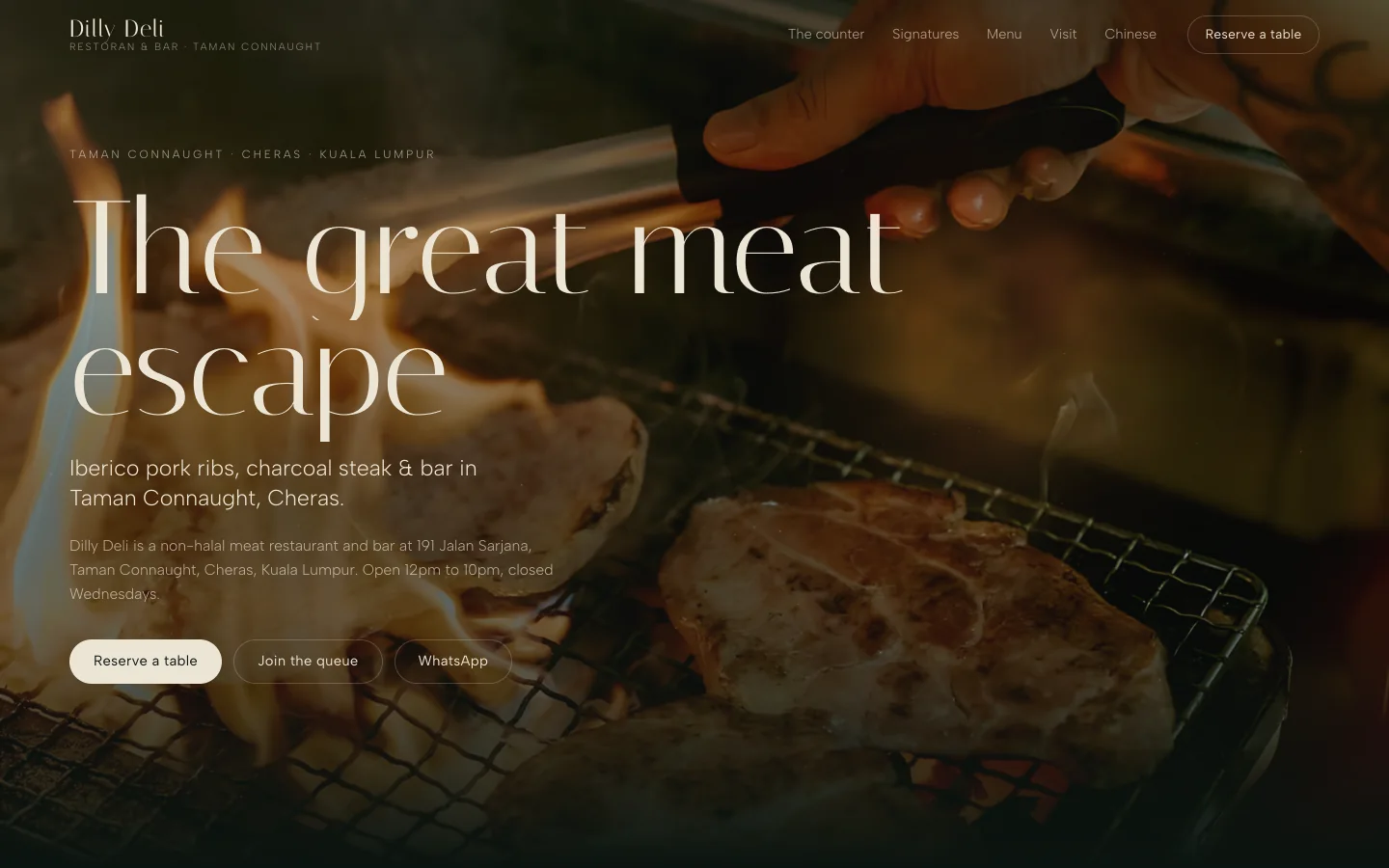
Dilly Deli
A restaurant site in English and 中文 with reservations, a walk-in queue and WhatsApp, plus an online shop and the operator console behind it, built and not yet switched on.
A restaurant website from CodaMinds is a site in English, 中文 and Bahasa Melayu with ordering and bookings on your own address, and one console for every outlet. It suits restaurants, cafés, kopitiams, hotpot places and multi-outlet groups. WhatsApp stays for conversations, the routine traffic moves to the site, and we run it after launch.
Steven Lim started the studio in Kuala Lumpur in 2021 and has built apps and websites since 2016. We built the live site for a restaurant in Cheras, we run our own booking, queue and review platform for restaurants, and every day we operate a live product with bookings and payments, so we know what an ordering page needs once real diners rely on it. The person you message is the person who builds your site, in English, 中文 or Bahasa Melayu. We meet restaurant owners in person across the Klang Valley, and work with restaurants in the rest of Malaysia, Singapore and further abroad over WhatsApp and a shared draft link.
A single outlet can live on a delivery app and a WhatsApp number. Once there is a second outlet, or a central kitchen behind the first, the website has to do real work: take orders, take bookings, run the queue and show the owner every outlet at once. The complaints owners and diners voice are the same everywhere: the commission on every delivery order, the table booked and never claimed, the QR menu with a font too small to read, and staff who are harder to find each year. Seven things fix that.
Delivery apps bring new customers, and they take a commission on every order. They are a channel, not your shop. Your own site takes orders for pickup and delivery on your own address, with the menu, the cart and payment in your language and the customer's. The order lands in the console, the kitchen sees it the way it sees a table order, and the customer's number and order history stay with you, with their consent. The delivery apps keep running beside it. The regulars who already know you order direct.
A booking page takes the date, the time, the party size and the outlet, and lands the booking in that outlet's calendar. Where your policy asks for a deposit, the page takes it before the booking is confirmed, and the no-show rule you set is shown to the guest before they confirm, so nobody is surprised. The confirmation and the reminder before the visit go out from the booking page itself, with a link to change or cancel. A booking can be tied to the guest's phone number, so a slot for a popular sitting is not passed around, and a festive menu can carry its own deposit rule for large groups.
On a busy night the queue is the first thing a guest meets. A walk-in queue on the site gives each party a number and a page they can watch on their phone, so they can wait at the shop next door instead of at your door. The host stand sees the list, calls the next party and marks the ones who left. The same queue runs at every outlet, and the owner sees how long guests waited at each.
QR ordering suits a table that stays a while and a kitchen that wants orders without a waiter in the middle. Some diners do not want it: the steps are too many, the font is too small, or there is no signal at the back of the shop. So we build both. The QR menu and the printed menu come from one list of dishes and prices in the console, so a change is made once. Staff can key in an order for a table that prefers paper, and it joins the same kitchen queue.
A QR on the table or the receipt opens the review page for that outlet, so the review is written by someone who just ate there. We do not buy reviews or filter them by rating. A review from a guest who sat at your table that night is worth more than any of that, and it builds slowly and stays.
Every outlet runs on the same console. Orders from the site, from the QR menu and from the floor arrive in one list per outlet. Stock is counted per outlet, a dish that runs out is hidden from the menu at that outlet alone, and the daily report shows each outlet beside the others. A central kitchen that supplies the outlets takes its orders through the same console. Staff see their outlet; the owner sees all of them. The console also keeps the records an e-invoice needs, which matters for a group: under LHDN's e-Invoice Guideline (version 4.8), an outlet below the turnover threshold loses its exemption when a holding company, a corporate shareholder or a related company is above it, which is how many restaurant groups are set up. Your accountant confirms what applies to you.
Many restaurants serve diners who read 中文 at home, Bahasa Melayu at work and English on the menu. Each language is a real set of pages with its own address, so a diner who searches in 中文 finds the 中文 page. The menu is translated once in the console, not page by page. Staff can run the console in one language while diners order in another.
Two dates set the shape of early 2027. Chinese New Year falls on Saturday 6 February 2027, and Ramadan is expected to begin around 8 February 2027. Reunion-dinner bookings and iftar bookings therefore arrive in the same week, and so do the deposits, the group sizes and the special menus. Hotels in Kuala Lumpur publish their Chinese New Year menus from late November, so a restaurant that wants the reunion-dinner bookings needs its menu and its booking page up before then.
A booking page built for this takes a festive menu as its own bookable item, with its own sittings and its own deposit rule for large groups, and closes it when the room is full. The year-end dinners and the school holidays follow the same pattern: a menu, a sitting and a deposit rule in the console, rather than a thread of messages to scroll through.
Three live products carry the pieces a restaurant site needs.
A restaurant site in English and 中文 with reservations, a walk-in queue and WhatsApp, plus an online shop and the operator console behind it, built and not yet switched on.
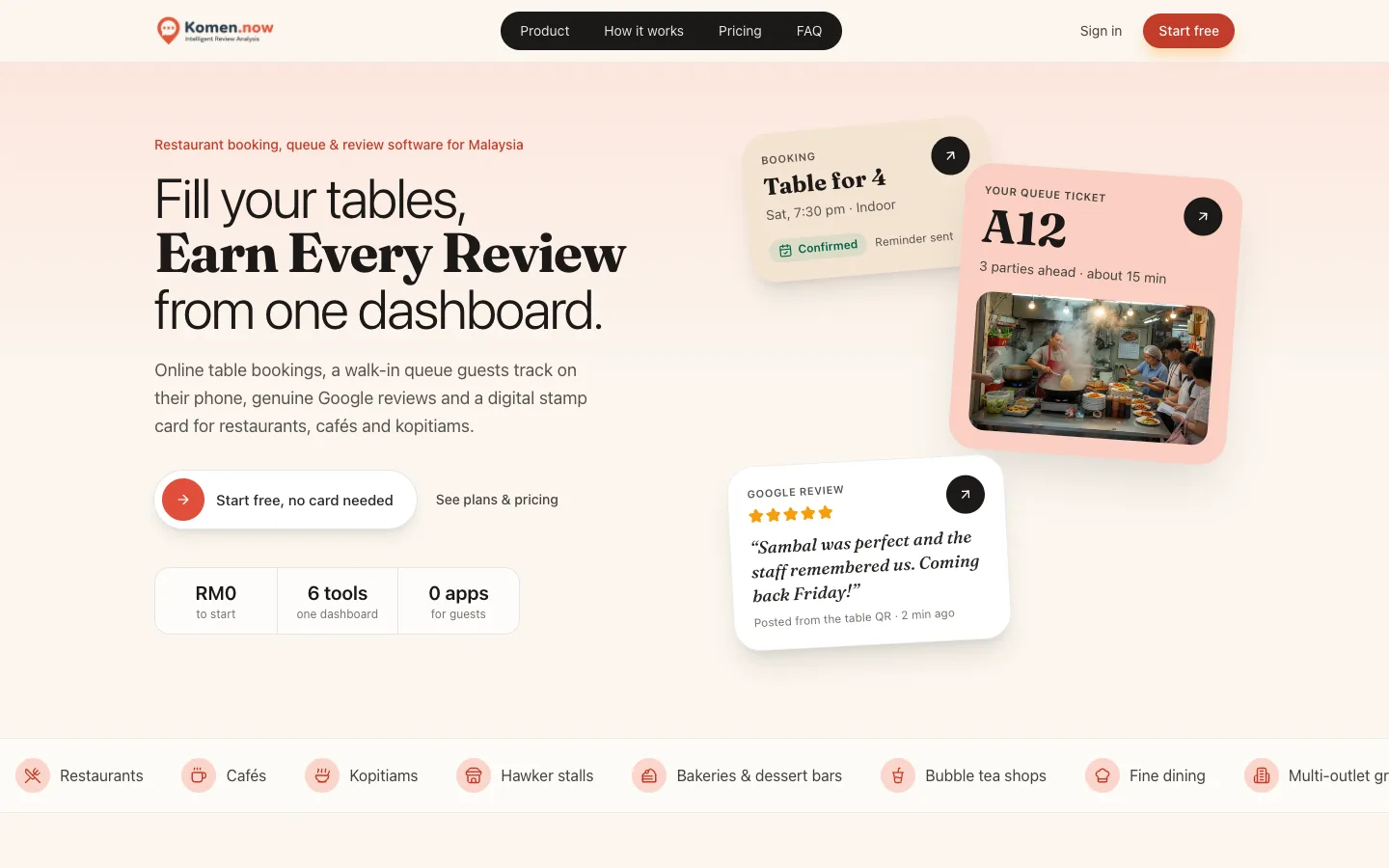
Bookings with confirmations and reminders, a walk-in queue guests follow on their phone, reviews from a table QR and a digital stamp card, in one dashboard for restaurants.
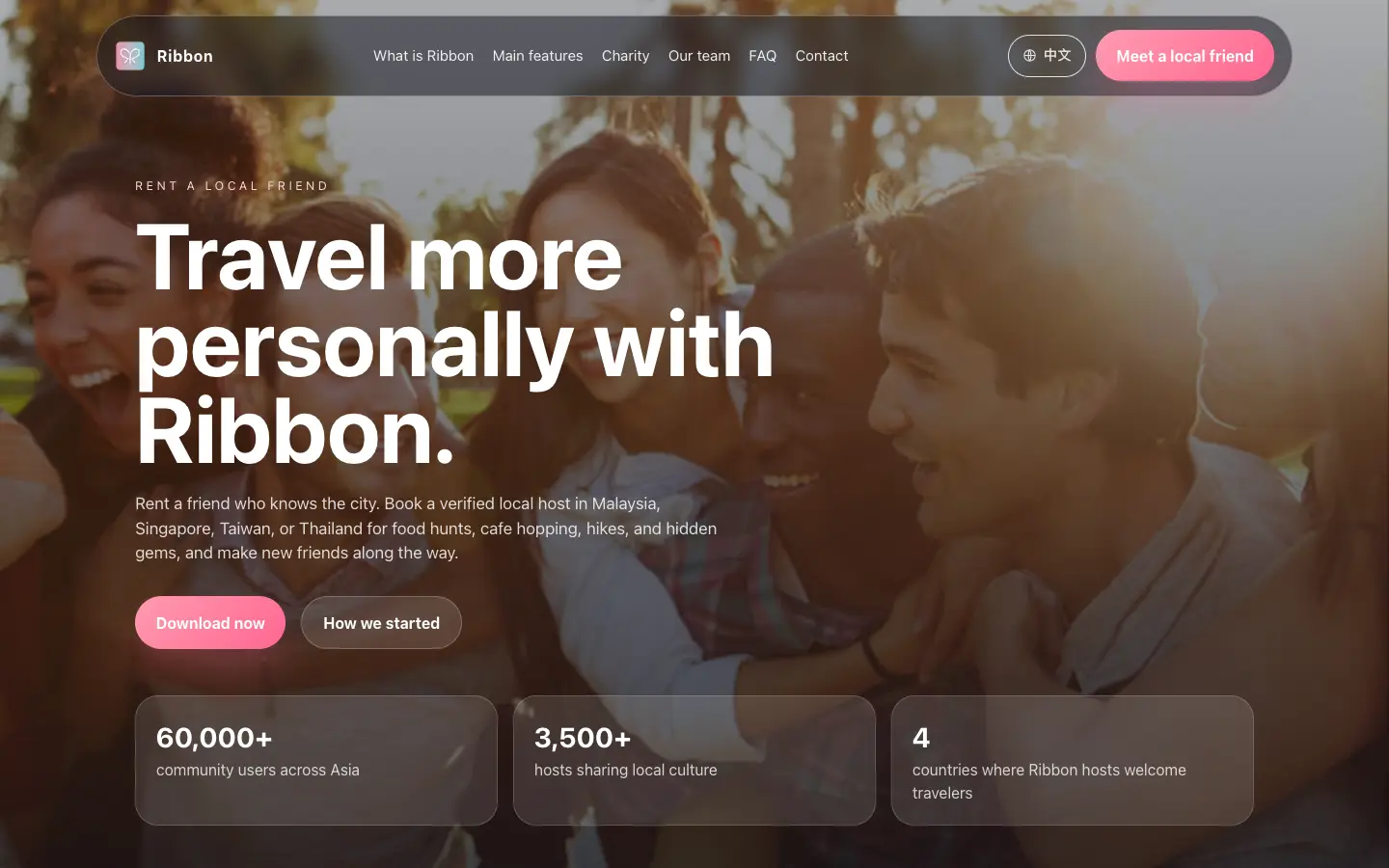
Runs bookings, payments and payouts every day, which is the same machinery an ordering page and a deposit need behind them.
Brief. You tell us the outlets, the menu, the languages and what the site should take: orders, bookings, the queue or all three. We reply with questions and a written scope.
Fixed quote. One price for that scope, agreed before any work starts. Anything outside it is quoted first.
Draft on your phone. You open the draft link, place an order and make a booking as a guest would, and mark what to change. We revise until you sign off.
Launch. We put the site live on your domain, with hosting in the restaurant's name, and hand over every file, the console included.
Care after launch. A new outlet, a new menu, a festive sitting or a price change is a message away, each quoted before it starts. See website maintenance.
Yes. The site takes orders for pickup and delivery on your own address, with the menu, the cart and payment, and the order lands in the same console your kitchen already watches. The delivery apps keep running beside it as a channel for new customers. Your regulars order direct, and their number and order history stay with you.
Yes. Where your policy asks for a deposit, the booking page takes it before the booking is confirmed, and the no-show or late-cancellation rule you set is shown to the guest before they confirm. The confirmation and the reminder go out from the booking page with a link to change or cancel. We do not promise a no-show figure, because it depends on your guests and your policy.
No, unless you want it to. We build the QR menu and the printed menu from the same list in the console, so a change is made once. Some diners find QR ordering too many steps or the font too small, and some tables have no signal, so staff can key in an order for a table that prefers paper and it joins the same kitchen queue.
Yes. Each outlet has its own orders, bookings, queue, stock and daily report, and the owner sees every outlet in one console. A dish that runs out is hidden at that outlet alone, a central kitchen takes its orders through the same console, and staff see only their own outlet. The console also keeps the records an e-invoice needs, since under LHDN's e-Invoice Guideline (version 4.8) an outlet below the turnover threshold loses its exemption when a holding company, a corporate shareholder or a related company is above it.
Yes. English, 中文 and Bahasa Melayu in any combination, each a real set of pages on its own address that search engines can find, not a translation widget. The menu is translated once in the console. Staff can run the console in one language while diners order in another, and every language is checked on real phones before launch.
Yes. The number stays yours, on your phone or at the host stand, and every page opens a chat to it with one tap. The routine traffic, order updates, booking confirmations and reminders, goes out from your own site instead. Since 1 October 2026, order updates and reminders sent through the WhatsApp Business Platform are charged per message and free-form replies are free only up to a monthly allowance, so fewer routine messages means a smaller bill and staff answering only the messages that need a person.
Send us the outlets, the menu, the languages and whether you want orders, bookings, the queue or all three. Tap the button to message us on WhatsApp and get a fixed quote for your restaurant website.
WhatsApp us